Sagarmala, 'Coal Corridor', and MPA
Three interrelated national initiatives: the 2016 Sagarmala plan, the 2016 National Waterways* Act, and the 2021 Major Ports Authority Act*, facilitate the transportation of coal through Goa. The Sagarmala plan is a national initiative that aims to boost port-led development and improve port connectivity with industries through roads, rail, and inland and coastal waterways. For Goa, the Sagarmala plan aims to construct infrastructure to increase Mormugao Port Authority's coal handling capacity to 51 million tonnes by 2035 and to 'efficiently' evacuate coal from the port to Karnataka steel plants. Projects proposed under this plan include the South Western Railway double-tracking, the expansion of the NH-4A and NH-17B highways, the construction of the Tanmar power transmission line, and the redevelopment of berths 8, 10, and 11 at the MPA. The Goa government's construction of the new Borim bridge* is also said to enable coal transportation.
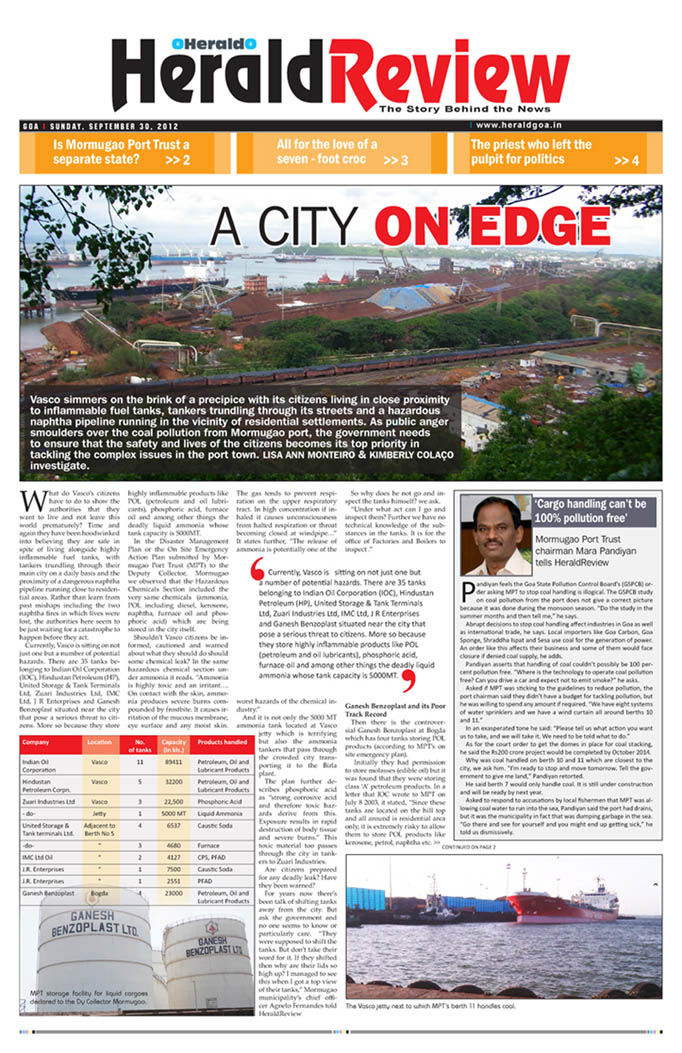
For the last two decades, the citizens of Goa have been protesting against the conversion of Goa into a 'coal corridor' and the expansion of the Mormugao Port Authority (MPA) (previously called Mormugao Port Trust) that would facilitate transporting coal from the MPA to Karnataka steel plants. Coal imports from Australia, Indonesia, Mozambique, and South Africa enter India through the MPA. Increase in coal imports can be traced back to the 2012 Supreme Court ban on iron-ore mining and restrictions on its exports. As iron-ore exports fell, the MPA suffered a revenue loss, and the port repositioned itself as a multi-commodity port, with coal as one of its main cargoes. Coal imports jumped from 7 million tonnes in 2012-2013 to 12 million tonnes in 2015-2016, and continued to increase thereafter. As of mid-2026, the process to increase the coal import limit from 12 to over 15 million tonnes is underway across berths 5, 6, and 7 that are handled by the corporations Jindal South Western Port Ltd and Adani Mormugao Port Terminal Pvt Ltd.
Coal handling and transportation are hazardous. Coal handling causes dust pollution in areas and villages around the port and along transportation routes. It severely impacts public health, causing chronic respiratory ailments among residents and lowering living standards. It also affects fishing and agriculture by contaminating water bodies and fields, reducing crop yields. Transportation infrastructure projects also cause reductions in forest cover, biodiversity loss, displacement of people and wildlife, loss of heritage sites and agricultural fields, and disruption of residents' livelihoods.
Consequently, various non-governmental organisations and coalition groups, composed of residents, activists, environmentalists, and lawyers, such as Goa Against Coal, Goencho Ekvott, Goa Federation, Federation of Rainbow Warriors, and Amche Mollem, are challenging these projects. The Goa Against Coal and the Old Cross Fishing Canoe Owners' Association, for instance, challenged berth expansions under the MPA in the National Green Tribunal, ensuring orders to conduct public hearings. Recent citizen initiatives continue to resist infrastructural expansion through the 2020 Save Mollem movement and protests against the new Borim bridge.
*(For more information on the National Waterways and the Major Ports Authority Act; the Save Mollem movement and Borim Bridge protest, please visit their tabs on the website).